Quadratic equation calculator
Quadratic equation has the basic form: ax2+bx+c=0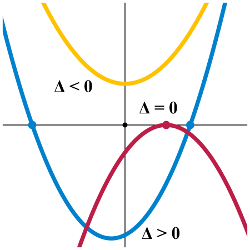
Calculation:
502=602+c2−2∗60∗c∗0.17364817766693 −c2+20.838c−1100=0 c2−20.838c+1100=0 p=1;q=−20.838;r=1100 D=q2−4pr=20.8382−4⋅1⋅1100=−3965.7868696585 D<0 c1,2=2p−q±D=220.84±−3965.79 c1,2=220.84±i3965.79 c1,2=10.418891±31.487247i c1=10.418891+31.48724690116i c2=10.418891−31.48724690116i Factored form of the equation: (c−10.418891−31.48724690116i)(c−10.418891+31.48724690116i)=0
Solution in text:
-c2+20.837781320032c-1100=0 ... quadratic equationDiscriminant:
D = b2 - 4ac = -3965.7868696585
D < 0 ... The equation has two distinct complex roots
c1 = 10.4188907+31.4872469i
c2 = 10.4188907-31.4872469i
P = {10.4188907+31.4872469i; 10.4188907-31.4872469i}