Quadratic Equation Calculator
A quadratic equation has the basic form: ax2+bx+c=0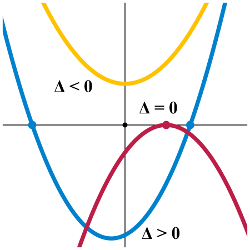
Calculation:
(9x−4)∗(3x−2)=8+5x 27x2−35x=0 a=27;b=−35;c=0 D=b2−4ac=352−4⋅27⋅0=1225 D>0 x1,2=2a−b±D=5435±1225 x1,2=5435±35 x1,2=0.648148±0.648148 x1=1.296296296 x2=0 Factored form of the equation: 27(x−1.296296296)x=0
Solution in text:
27x2-35x=0 ... c=0; quadratic equation without constant termDiscriminant:
D = b2 - 4ac = 1225
D > 0 ... The equation has two distinct real roots
x1 = 1.2962963
x2 = 0
P = {1.2962963; 0}