Quadratic Equation Calculator
A quadratic equation has the basic form: ax2+bx+c=0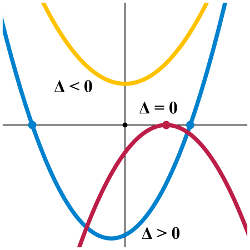
Calculation:
4x2−5x+34=x(x−2) 3x2−3x+34=0 a=3;b=−3;c=34 D=b2−4ac=32−4⋅3⋅34=−399 D<0 x1,2=2a−b±D=63±−399 x1,2=63±i399 x1,2=0.5±3.329164i x1=0.5+3.3291640592397i x2=0.5−3.3291640592397i Factored form of the equation: 3(x−0.5−3.3291640592397i)(x−0.5+3.3291640592397i)=0
Solution in text:
3x2-3x+34=0 ... quadratic equationDiscriminant:
D = b2 - 4ac = -399
D < 0 ... The equation has two distinct complex roots
x1 = 0.5+3.3291641i
x2 = 0.5-3.3291641i
P = {0.5+3.3291641i; 0.5-3.3291641i}