Quadratic Equation Calculator
A quadratic equation has the basic form: ax2+bx+c=0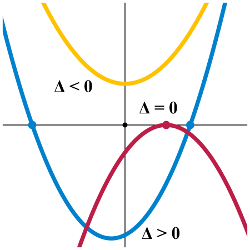
Calculation:
n/2∗(n−3)=275 0.5n2−1.5n−275=0 a=0.5;b=−1.5;c=−275 D=b2−4ac=1.52−4⋅0.5⋅(−275)=552.25 D>0 n1,2=2a−b±D=11.5±552.25 n1,2=1.5±23.5 n1=25 n2=−22 Factored form of the equation: 0.5(n−25)(n+22)=0
Solution in text:
0.5n2-1.5n-275=0 ... quadratic equationDiscriminant:
D = b2 - 4ac = 552.25
D > 0 ... The equation has two distinct real roots
n1 = 25
n2 = -22
P = {25; -22}