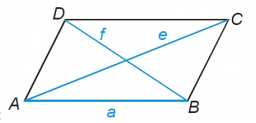
Given are 3
Two statements are given:
First statement: "If a quadrilateral is a parallelogram, then its diagonals bisect each other."
Second statement: "If the diagonals of a quadrilateral bisect each other, then the quadrilateral is a parallelogram."
How many of the following assertions about the given statements are true?
● The first statement is true.
● The second statement is false.
● The second statement is an equivalence.
● The second statement is the negation of the first.
Your answer:
First statement: "If a quadrilateral is a parallelogram, then its diagonals bisect each other."
Second statement: "If the diagonals of a quadrilateral bisect each other, then the quadrilateral is a parallelogram."
How many of the following assertions about the given statements are true?
● The first statement is true.
● The second statement is false.
● The second statement is an equivalence.
● The second statement is the negation of the first.
Your answer:
You need to know the following knowledge to solve this word math problem:
arithmeticplanimetrythemes, topicsGrade of the word problem
We encourage you to watch this tutorial video on this math problem: video1
Related math problems and questions:
- Quadrilaterals
 Which of the following statements about angles in quadrilaterals is false? a. In a right-angled trapezoid, exactly one interior angle is obtuse. b. The diagonals of a rhombus are perpendicular to each other. c. The sum of any two interior angles on the sa
 - Statements true/false
 Which of the statements is not correct: ...
 - Trapezoid
 In a right-angled trapezoid, are the diagonals perpendicular to each other, and do they bisect the angles?
 - True and false
 A circle k(S; 8 cm) is given. Furthermore, points K, L are given such that the following holds: the length of SL is 6 cm, the length of SM is greater than 8 cm. Which of the following statements is not true a. The circle m(M; |ML|) has exactly two common
 - Giraffes to monkeys
 The ratio of the number of giraffes to the number of monkeys in a zoo is 2 to 5. Which statement about the giraffes and monkeys could be true? A. For every 10 monkeys in the zoo, there are 4 giraffes. B. For every giraffe in the zoo, there are three monke
 - 1/12 fraction
 Which statement about determining the quotient 1/12÷3 is true? A. Because 1/36×3=1/12, 1/12 divided by 3 is 1/36. B. Because 1/4×3=1/12, 1/12 divided by 3 is 1/4. C. Because 3/4×3=1/12, 1/12 divided by 3 is 3/4. D. Because 4/3×3=1/12, 1/12 divided by 3 is
 - Coins in a money box
 Karol has in his money box in total 19 coins, and only ten-crown and fifty-crown coins. In total he has in the money box 830 Kč saved. Which statement is false? (Provide a solution procedure for the individual statements.) a) In the money box 170 Kč (Czec