Voltmeter range
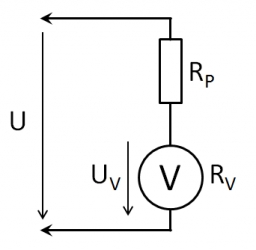
We have a voltmeter that, in its original setting, measures up to 10 V. Calculate the resistance of the series resistor (multiplier) needed to extend the range to 50 V. The voltmeter's internal resistance is 2 kΩ/V.
Your answer:
Your answer:
You need to know the following knowledge to solve this word math problem:
algebrathemes, topicsGrade of the word problem
Related math problems and questions:
- Resistor voltage measurement
 We measured the voltage U= 75 V between the circuit's external terminals with a voltmeter. The circuit's resistance values of the individual resistors (in series) are 50 Ohm and 100 Ohm. Find out what voltage we would measure on the 1st and 2nd resistors.
 - Effective and mean voltage
 A voltage divider consisting of resistors R1 = 103000 Ω and R2 = 197000 Ω is connected to the ideal sine wave voltage source. R2 is connected to a voltmeter, which measures the mean voltage and has an internal resistance R3 = 200300 Ω. The measured value
 - Resistor voltage
 The current of 25 mA passes through the resistor with a resistance of 50 Ω. How much voltage do we measure on it?
 - Resistor series connection
 Three resistors with resistances of 200 Ω, 400 Ω, and 600 Ω are connected in series (in series)—a current of 1.8 A flows through the first 200 Ω resistor. a) What current passes through the second and what current through the third resistor? b) What are t
 - Resistors
 Two resistors connected in parallel give a combined resistance of $R1 Ω, and connected in series give a combined resistance of $R2 Ω. Determine the resistance of each resistor.
 - Bulb 4
 In an electric circuit, a bulb (4.5 V, 0.1 A) and a resistor with resistance 45 Ω are connected to a 4.5 V voltage source. Will the bulb shine at full brightness in this circuit? Support your answer with calculations, and possibly look for solutions so th
 - Resistor voltage current A current of 5 mA flows through a resistor with an electrical resistance of 600 Ω. What electrical voltage do we measure between the resistor terminals?