Perimeter and legs
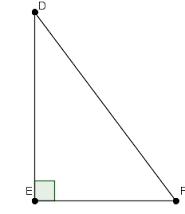
Determine the perimeter of a right triangle if the length of one leg is 75%, the length of the second leg, and its area is 24 cm2.
Your answer:
Your answer:
Tips for related online calculators
Are you looking for help with calculating roots of a quadratic equation?
Our percentage calculator will help you quickly and easily solve a variety of common percentage-related problems.
See also our right triangle calculator.
Do you want to convert length units?
See also our trigonometric triangle calculator.
Our percentage calculator will help you quickly and easily solve a variety of common percentage-related problems.
See also our right triangle calculator.
Do you want to convert length units?
See also our trigonometric triangle calculator.
You need to know the following knowledge to solve this word math problem:
algebraarithmeticplanimetrybasic operations and conceptsUnits of physical quantitiesGrade of the word problem
Related math problems and questions:
- Isosceles Triangle Area
 In an isosceles triangle, the base length is equal to 75% of the arm's length. If the circumference is 22 cm, determine the area of the triangle.
 - RT 11
 Calculate the area of the right triangle if its perimeter is p = 45 m and one leg is 20 m long.
 - Right triangle eq2
 The hypotenuse of a right triangle is 9 cm longer than one leg and 8 cm longer than the other leg. Determine the perimeter and area of the triangle.
 - Arm-leg
 Calculate the length of the base of an isosceles triangle with a circumference of 224 cm if the arm length is 68 cm.
 - AP RT triangle
 The length of the sides of a right triangle forms an arithmetic progression, and the longer leg is 24 cm long. What are the perimeter and area?
 - Triangular prism
 The base of the perpendicular triangular prism is a rectangular triangle with a hypotenuse of 10 cm and one leg of 8 cm. The prism height is 75% of the perimeter of the base. Calculate the volume and surface of the prism.
 - Hypotenuse
 Calculate the length of the hypotenuse of a right triangle if the length of one leg is 4 cm and its area is 16 square centimeters.