Pyramid Z8–I–6
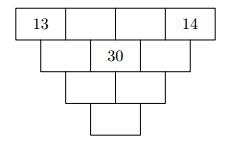
Each brick of the pyramid contains one number. Whenever possible, the number in each brick is the lowest common multiple of two numbers of bricks lying directly above it.
May that number be in the lowest brick? Determine all possibilities.
Your answer:
May that number be in the lowest brick? Determine all possibilities.
Your answer:
Tips for related online calculators
Do you want to calculate the least common multiple of two or more numbers?
You need to know the following knowledge to solve this word math problem:
algebrabasic operations and conceptsthemes, topicsGrade of the word problem
Related math problems and questions:
- Planting of flower beds
 A gardener has to plant three flower beds, each with just one kind of plant. The number of possibilities to plant these 3 flower beds with three different kinds of plants is 133 less than the number of possibilities to plant these beds with at most three
 - Four classses
 Students of all 7, 8, and 9 classes in one school may take up 4, 5, 6, and 7 abreast, and nobody will be left. If there are always four classes in each grade, what is the average number of pupils in one class?
 - Brick
 The isosceles scale has all bricks; the second weight is 1 kg, and the 1/5 of brick is on one side. The balance is in equilibrium. What is the weight of a brick?
 - Purchased
 Milo shopped in a store where the prices of all goods were listed in whole euros. If Milo bought 2 milks, 3 glasses, and 1 pack of sweets, he would pay €49. If he bought 5 more milks, 11 glasses, and 1 pack of sweets, he would pay €154 in total. How many
 - Digits
 How many odd four-digit numbers can we create from digits 0, 3, 5, 6, and 7? (a) the figures may be repeated (b) the digits may not be repeated
 - Unknown number
 An unknown number is divisible by exactly three different primes. When we compare these primes in ascending order, the following applies: • The difference between the first and second prime numbers is half the difference between the third and second prime
 - Brick transportation calculation
 They drove X bricks seven times by car. If they always loaded the same number of bricks, how many bricks did they move at once?