Cube Surface Ratio Edges
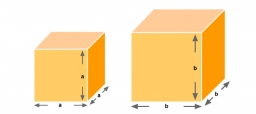
The lengths of the edges of the two cubes are in the ratio 2:3. Determine how many times the surface of the larger cube is larger than the surface of the smaller cube.
Your answer:
Your answer:
Tips for related online calculators
Check out our ratio calculator.
You need to know the following knowledge to solve this word math problem:
arithmeticsolid geometrybasic operations and conceptsGrade of the word problem
Related math problems and questions:
- Cube edge ratio
 The lengths of the edges of two cubes are in the ratio 1:2, determine: a) the ratio of the area of the wall of the smaller cube to the area of the wall of the larger cube. b) the ratio of the surface of the smaller cube to the surface of the larger cube.
 - Magnified cube
 If the lengths of the cube's edges are extended by 5 cm, its volume will increase by 485 cm³. Determine the surface of both the original and the magnified cube.
 - Base of prism
 The base of the perpendicular prism is a rectangular triangle whose legs lengths are at a 3:4 ratio. The height of the prism is 2 cm smaller than the larger base leg. Determine the volume of the prism if its surface is 468 cm².
 - Cube Surface from Smaller
 We will create a larger cube from 27 cubes with an edge of 2 cm. Determine the surface of the built cube.
 - Cube volume comparison
 There are two cubes. One has an edge of 9 dm and the second of 9 cm. How often does the largest cube have a larger volume than a smaller one?
 - Cubes
 The surface areas of two cubes, whose edges differ by 42 cm, differ by 16128 cm². Determine the edge length of each cube.
 - Cube edge volume
 The sum of the lengths of all the cube's edges is 60 cm. How to calculate its volume?