A charge
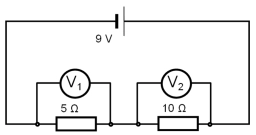
A charge of 9 C passes through series-connected resistors with resistances of 40 ohms and 60 ohms in 1 minute. a) What voltage are they connected to? b) Calculate the voltage across each resistor.
Your answer:
Your answer:
You need to know the following knowledge to solve this word math problem:
themes, topicsGrade of the word problem
Related math problems and questions:
- Resistor series voltage
 Resistors with resistances of 6 ohms and 10 ohms are connected in series to a voltage of 24 V. a) How much current passes through them? b) What are the voltages on the individual resistors?
 - Resistor series connection
 Three resistors with resistances of 200 Ω, 400 Ω, and 600 Ω are connected in series (in series)—a current of 1.8 A flows through the first 200 Ω resistor. a) What current passes through the second and what current through the third resistor? b) What are t
 - Resistor series connection
 Two resistors with resistances of 40 ohms and 60 ohms are connected in series and connected to a voltage of 150 V. A) the total resistance B) current in the circuit C) voltage on both resistors
 - Resistors in a circuit
 Two resistors with resistances 30 and 50 Ohm are connected in series in a circuit. Between the outer terminals of the resistor there is a voltage of 20 V. Draw the circuit diagram and record into it all quantities. What current passes through the first an
 - Resistor parallel connection
 Three resistors with resistances of 200 Ω, 400 Ω, and 600 Ω are connected next to each other (parallel). A current of 1.8 A flows through the first 200 Ω resistor. a) What current passes through the second and what current through the third resistor? b) W
 - Serial connection
 If the voltage on the first resistor is 6 V and the resistance ratio of the first and second resistors is 1:3, what will be the voltage across the second resistor if they are connected in series?
 - Kirchhoff's law
 Two resistors with 100 Ω and 300 Ω resistors are connected in series. A current of 1.8 A passes through the first 100 Ω resistor. What current flows through the second resistor?