Quadrangle ACEG
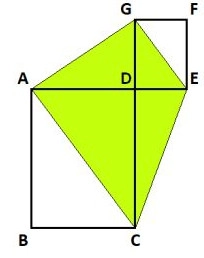
The figure shows two rectangles ABCD and DEFG, with |DE| = 3 cm, |AD| = 6 cm, |DG| = 5 cm, and |CD| = 10 cm. Calculate the area of quadrilateral ACEG.
Figure description: the two rectangles share vertex D. Rectangle ABCD has sides twice as long as those of DEFG. All sides are either parallel or perpendicular to each other.
Your answer:
Figure description: the two rectangles share vertex D. Rectangle ABCD has sides twice as long as those of DEFG. All sides are either parallel or perpendicular to each other.
Your answer:
Tips for related online calculators
You need to know the following knowledge to solve this word math problem:
planimetryGrade of the word problem
We encourage you to watch this tutorial video on this math problem: video1
Related math problems and questions:
- Quadrilateral perimeter angles
 Quadrilateral ABCD has side lengths AB=13 cm, CD=3 cm, AD=4 cm. Angles ACB and ADC are right angles. Calculate the perimeter of quadrilateral ABCD.
 - Diagonal
 The rectangular ABCD trapeze, whose AD arm is perpendicular to the AB and CD bases, has an area of 15 cm². Bases have lengths AB = 6 cm and CD = 4 cm. Calculate the length of the AC diagonal.
 - Hexagons
 There is a square ABCD, a square EFGD, and a rectangle HIJD. Points J and G lie on side CD, with DJ less than DG, and points H and E lie on side DA, with DH less than DE. We also know that DJ equals GC. Hexagon ABCGFE has a perimeter of 96 cm, hexagon EFG
 - Trapezoid thirds
 The ABCD trapezoid has parallel sides AB and CD. The E point lies on the AB side. The segment DE divides the trapezoid into two parts with the same area. Find the length of the AE line segment.
 - Trapezium ABCD
 The figure shows ABDC is a trapezium in which AB || CD. Line segments RN and LM are drawn parallel to AB such that AJ=JK=KP. If AB=0.5 m and AP=BQ=1.8 m, find the lengths of AC, BD, RN, and LM. angle D=angle C=60
 - Trapezoid Perimeter Pythagorean
 The trapezoid ABCD is given (AB || CD, AB perpendicular to AD). Calculate its circumference if | AB | = 20 cm, | CD | = 15 cm, | AD | = 12 cm. Pythagorean theorem
 - Square quadrilateral area
 The picture shows a square ABCD with the center S and the side 8 cm long. Point E is any point on the CD side other than C and D. Calculate the area of the ASBE quadrilateral in cm².