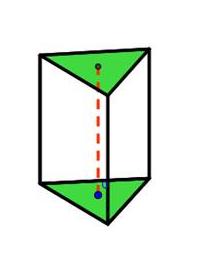
Triangular prism
The base of a right triangular prism is a right triangle with hypotenuse 14 cm and one leg 9 cm. The height of the prism equals 2/9 of the base's perimeter. Calculate the surface area of the prism.
Your answer:
Your answer:
Tips for related online calculators
You need to know the following knowledge to solve this word math problem:
arithmeticsolid geometryplanimetryGrade of the word problem
Related math problems and questions:
- Triangular prism
 Calculate the volume and surface of the triangular prism ABCDEF with the base of an isosceles triangle. Base's height is 16 cm, leg 10 cm, base height vc = 6 cm. The prism height is 9 cm.
 - Triangular prism
 The base of the perpendicular triangular prism is a rectangular triangle with a hypotenuse of 10 cm and one leg of 8 cm. The prism height is 75% of the perimeter of the base. Calculate the volume and surface of the prism.
 - Right prism
 The base of the right prism is a right triangle with leg a = 5 cm and a hypotenuse c = 13 cm. The height of the prism is equal to the circumference of the base. Calculate the surface area and volume of the prism.
 - Triangular prism
 Calculate a triangular prism if it has a rectangular triangle base with a = 4 cm and hypotenuse c = 50 mm, and the height of the prism is 0.12 dm.
 - Triangular prism
 Calculate the surface of a regular triangular prism; the base's edges are 6 cm long, and the height of the prism is 15 cm.
 - Triangular prism
 The base of the perpendicular triangular prism is a right triangle with a leg length of 5 cm. The area of the largest sidewall of its surface is 130 cm², and the body's height is 10 cm. Calculate its volume.
 - Calculate a prism
 Calculate the volume and surface area of a prism whose height is 16 cm and whose base is a right triangle with sides of 5 cm and 12 cm and a hypotenuse of 13 cm.