The trench
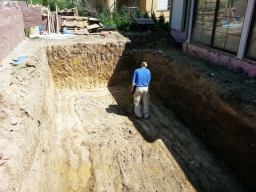
Calculate how many cubic meters of soil need to be removed from the excavation in the shape of an isosceles trapezoid. The top width is 3 meters, the lower width is 1.8 m, the excavation depth is 1 m, and the length is 20 m.
Your answer:
Your answer:
Tips for related online calculators
Tip: Our volume units converter will help you convert volume units.
You need to know the following knowledge to solve this word math problem:
solid geometryplanimetryUnits of physical quantitiesGrade of the word problem
Related math problems and questions:
- Road excavation volume
 When building a new road, excavating a 280 m long road in the ground was necessary. The bottom width, where the road runs, was 20 m wide. At the top, the entire excavation was 30 m wide. The depth of the excavation is 6 m. How much m³ of soil had to be re
 - Ditch excavation
 How much soil needs to be removed when digging a 200 meter long ditch whose cross-section is an isosceles trapezoid with an area of 4812.5 cm²?
 - Cross-section - digging
 How many m³ of soil is to be excavated when digging a 120 m long ditch, the cross-section of which is an isosceles trapezoid with bases of 2.3 m and 3.3 m, if the depth of the trench is 90 cm?
 - Road embankment
 Road embankment has a cross-section shape of an isosceles trapezoid with bases 7 m and 10 m and 5 m long leg. How many cubic meters of soil is in an embankment length of 1198 meters?
 - Isosceles ditch
 A ditch with a cross-section in the shape of an isosceles trapezoid with bases of 3 m and 5 m and arms of length 2 m is 2.5 meters deep and 10 meters long. How many cubic meters of soil did they have to excavate when digging it?
 - Cesspool pit excavation
 The Horniakovs dug a pit for a cesspool in the shape of a cuboid with bottom dimensions of 40*40 dm and a depth of 350 cm. A) How many cubic meters of soil did they dig up? B) The excavated soil was evenly spread and pressed onto a rectangular area measur
 - Workers
 Workers are digging a jump pit in the schoolyard. The pit is cuboid in shape, with a length of 5 m, a width of 20 dm, and a depth of 36 cm. They excavate 0.4 cubic meters of soil an hour. How much time (hours and minutes) is needed to excavate this pit?