Rotation
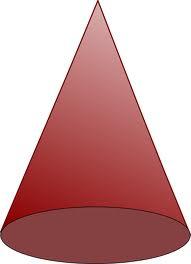
A right triangle with legs 11 cm and 18 cm is rotated around the longer leg.
Calculate the volume and surface area of the cone formed.
Your answer:
Calculate the volume and surface area of the cone formed.
Your answer:
Tips for related online calculators
Tip: Our volume units converter will help you convert volume units.
See also our right triangle calculator.
See also our trigonometric triangle calculator.
See also our right triangle calculator.
See also our trigonometric triangle calculator.
You need to know the following knowledge to solve this word math problem:
arithmeticsolid geometryplanimetrynumbersUnits of physical quantitiesGrade of the word problem
We encourage you to watch this tutorial video on this math problem: video1
Related math problems and questions:
- Triangle and Cone
 A right triangle has legs 3 cm and 4 cm long. Cone A was created by rotating this triangle around the longer leg, and cone B by rotating it around the shorter leg. Which cone has: a) a larger volume? b) a smaller lateral surface area? c) a larger total su
 - Cone volume surface
 A right triangle with perpendiculars a = 3 cm and b = 4 cm rotates around a longer perpendicular. Calculate the volume and surface area of the resulting cone.
 - RT area
 A right triangle has an area of 54 cm². Calculate the sizes of both legs if the shorter leg is 75% of the size of the longer leg.
 - Perpendicular legs PT
 In a right triangle, one leg is 5 cm longer than the other leg. The hypotenuse is 150 mm. Calculate the lengths of the legs.
 - Axial section
 Calculate the volume and surface of a cone whose axial section is an equilateral triangle with side length a = 18 cm.
 - Cone
 If the segment of the line y = -2x +3 that lies in the first quadrant is rotated about the y-axis, a cone is formed. What is the volume of the cone?
 - Surface of Rotating Cone
 The rotating cone has a height of 20 cm and a radius of 18 cm. Calculate its surface.