Tram - safe downhill
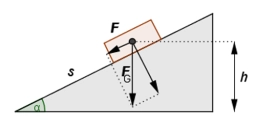
What is the maximum angle at which the tram can go downhill to still be able to stop? The coefficient of shear friction is f =0.15.
Your answer:
Your answer:
Tips for related online calculators
See also our right triangle calculator.
See also our trigonometric triangle calculator.
Try conversion angle units angle degrees, minutes, seconds, radians, grads.
See also our trigonometric triangle calculator.
Try conversion angle units angle degrees, minutes, seconds, radians, grads.
You need to know the following knowledge to solve this word math problem:
planimetrygoniometry and trigonometryUnits of physical quantitiesthemes, topicsGrade of the word problem
We encourage you to watch this tutorial video on this math problem: video1
Related math problems and questions:
- Shear friction
 How much force must be applied to a box weighing 300 kg to move it at a constant speed along a horizontal floor, if the coefficient of sliding friction between the box and the floor is 0.5?
 - Cart friction force
 An 80 kg cart moving at constant speed along a horizontal road is subjected to a pulling force of 120 N. Specify: a) the magnitude of the frictional force b) the value of the coefficient of shear friction.
 - Turn radius
 What is the smallest radius a turn must have for a car to enter safely without exceeding a speed of 50 km/h? The coefficient of shear friction between the tires and the surface is 0.4.
 - Four 12
 Four classmates (Ivan, Matej, Fero, Ľuboš), who go to school by the same tram connection, agreed that they would meet in the morning at the stop in front of the school. As they promised, so it happened. The first classmate arrived at the stop in front of
 - Tram lines
 Trams of five lines are driven at intervals of 5,8,10,12, and 15 minutes. At 12 o'clock, come out of the station at the same time. How many hours will we all meet again? How many times has each tram passed for this stop?
 - Tram stop
 At a tram stop, trams No. 4 and No. 5 were both present at 10:00 AM. Tram No. 4 runs every 5 minutes and tram No. 5 runs every 7 minutes. How many times will both trams be at the stop at the same time before 12:00 noon?
 - Tram meeting time
 Trams of five lines run at intervals of 5, 8, 10, 12, and 15 minutes. At noon, they left the station at the same time. What time will they meet again? How many times will each tram pass the stop during that time?