Equilateral triangle circle
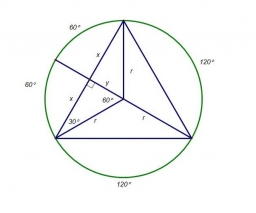
There is a circle with a radius of 2.5 cm and point A, which lies on it. Write an equilateral triangle ABC in the circle.
Your answer:
Your answer:
Tips for related online calculators
You need to know the following knowledge to solve this word math problem:
planimetryUnits of physical quantitiesthemes, topicsGrade of the word problem
We encourage you to watch this tutorial video on this math problem: video1
Related math problems and questions:
- Two tangents
 The figure shows a circle k with centre S and radius 5 cm, and a point A which is 13 cm from centre S. From point A, two tangents p and q are drawn to circle k, with points of tangency P and Q. In addition, another tangent t is drawn to circle k, intersec
 - Two chords
 There is a given circle k (center S, radius r). From point A, which lies on circle k, are starting two chords of length r. What angle do chords make? Draw and measure.
 - Equilateral triangle ABC
 In the equilateral triangle ABC, K is the center of the AB side, the L point lies on one-third of the BC side near point C, and point M lies on one-third of the side of the AC side closer to point A. Find what part of the ABC triangle contains the triangl
 - Point construction
 Given an isosceles right triangle ABS with base AB. On a circle centered at point S and passing through points A and B, point C lies such that triangle ABC is isosceles. Determine how many points C satisfy the given conditions and construct all such point
 - A circle 2
 A circle is centered at the point (-7, -1) and passes through the point (8, 7). The radius of the circle is r units. The point (-15, y) lies in this circle. What are r and y (or y1, y2)?
 - Circle
 The circle touches two parallel lines, p, and q, and its center lies on line a, which is the secant of lines p and q. Write the equation of the circle and determine the coordinates of the center and radius. p: x-10 = 0 q: -x-19 = 0 a: 9x-4y+5 = 0
 - Convex angle
 There is a circle k (S; r), and a point A, which lies on this circle. There is also a point B on the circumference, for which it is true that in one direction, it is five times further from point A than in the opposite direction (around the circumference