Dimensions of glass
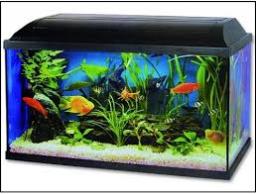
An aquarium has dimensions of 64 × 50 × 45 cm and is filled to 5 cm below the upper edge. How many liters of water are in an aquarium? How many square meters of glass are needed to produce an aquarium?
Your answer:
Your answer:
Tips for related online calculators
Do you know the volume and unit volume, and want to convert volume units?
You need to know the following knowledge to solve this word math problem:
solid geometryplanimetryUnits of physical quantitiesGrade of the word problem
We encourage you to watch this tutorial video on this math problem: video1
Related math problems and questions:
- Glass aquarium
 How many m² of glass are needed to produce an aquarium with a bottom dimension of 70 cm x 40 cm and a height of 50 cm?
 - Aquarium water calculation
 The square-shaped aquarium is 65 cm long, 24 cm wide, and 30 cm high. How many liters of water are in an aquarium if the water reaches 5 cm below its upper edge?
 - Railing 3
 A railing in a museum is filled with 18 glass panels in the shape of parallelograms with a side length of 40 cm and a corresponding height of 65 cm. How many m² of glass were needed to produce these panels?
 - Measuring aquarium
 The aquarium has the shape of a block measuring 80 cm, 30 cm, and 20 cm. The water level reaches 6 cm below the upper edge. How many liters of water are in the aquarium? (1 liter = 1 dm3)
 - Aquarium Dimensions and Volume
 The aquarium dimensions are in the ratio a: b: c = 5:2:4. 6600 cm² of glass was used for its production. How many liters of water will fit in the aquarium if it reaches 5 cm below its edge?
 - Aquarium water calculation
 The aquarium has the dimensions a = 250 cm, b = 50 cm, and c = 60 cm. Water is poured into the aquarium up to 45 cm. Do you calculate how many liters of water are in the aquarium?
 - Aquarium
 The box-shaped aquarium is 40 cm high; the bottom has 70 cm and 50 cm dimensions. Simon wanted to create an exciting environment for the fish, so he fixed three pillars to the bottom. They all have the shape of a cuboid with a square base. The base edge o