Cube into sphere
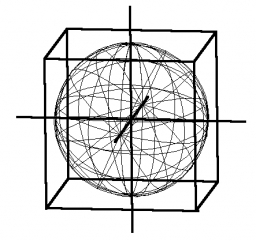
The cube has brushed a sphere as large as possible. Determine how much percent the waste was.
Your answer:
Your answer:
Tips for related online calculators
Our percentage calculator will help you quickly and easily solve a variety of common percentage-related problems.
Tip: Our volume units converter will help you convert volume units.
Tip: Our volume units converter will help you convert volume units.
You need to know the following knowledge to solve this word math problem:
algebrasolid geometrybasic operations and conceptsUnits of physical quantitiesGrade of the word problem
We encourage you to watch this tutorial video on this math problem: video1
Related math problems and questions:
- Eight
 Eight small Christmas balls with a radius of 1 cm have the same volume as one large Christmas ball. What has a bigger surface: eight small balls or one big ball?
 - Cylinder material waste
 A cylinder with the maximum possible base was ground from a wooden regular quadrilateral prism (edge 2.8 cm, height 7.5 cm). What percentage of the material was wasted as waste? What percentage would it be if the height of the prism were twice as large?
 - Lathe
 From the cube of edge, 41 cm was lathed a maximum cylinder. What percentage of the cube is left as waste after being lathed?
 - Radius of a sphere
 We turned a sphere with the largest possible radius from a cube with an edge length of 8 cm. Calculate the volume of the cube, the ball, and the percentage of waste when turning.
 - Waste separation
 14% of separated waste in Slovakia in 2007 consisted of plastics. The glass managed to separate twice as much. What% of separated waste was glass? What% of separated waste was another waste?
 - The roof
 The roof has a spherical canopy with a base diameter of 8 m and a height of 2 m. Calculate the foil area with which the roof is covered when calculating 13% for waste and residues.
 - Quadrilateral and angles
 In a quadrilateral, angle α is twice as large as angle β. Angle γ is 80% of angle α, and angle δ is 30° greater than angle α. Determine the angles of this quadrilateral.