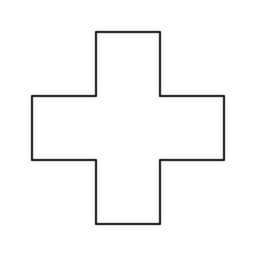
Resulting cross
From the corners of the square with a side length of 10 cm, we cut out small squares with a side length of 3 cm. What is the area of the resulting cross?
Your answer:
Your answer:
You need to know the following knowledge to solve this word math problem:
arithmeticplanimetryUnits of physical quantitiesGrade of the word problem
We encourage you to watch this tutorial video on this math problem: video1
Related math problems and questions:
- Cube corners
 We cut a small cube with an edge length of 2 cm from each corner of a large cube with an edge length of 10 cm. How many cm³ was the body left from the big cube after cutting the small cubes?
 - Z6–I–5 MO 2019
 The shape in the picture was created by cutting a small cross out of a large cross. Each of these crosses can be composed of five identical squares, with the sides of the small squares being half the length of the sides of the large squares. The area of t
 - Octagon
 We have a square with side 56 cm. We cut the corners to create a regular octagon. What is the side length of the octagon?
 - Square metal sheet
 We cut out four squares with a 300 mm side from a square sheet metal plate with a side of 0.7 m. Express the fraction and the percentage of waste from the square metal sheet.
 - Squares
 Cut out the square with the integer side from the square with the integer side so that the residual area is 100. What is the longest possible side of the larger square?
 - Paper squares
 We need to cut a paper rectangle measuring 69 cm by 46 cm into the largest possible identical squares. Calculate the side length of the squares and their number.
 - Paper box
 The hard rectangular paper has dimensions of 60 cm and 28 cm. We cut off the corners into equal squares, and the residue was bent to form an open box. How long must the largest volume of the box be beside the squares?