Equilateral cylinder
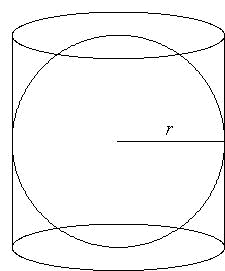
A sphere is inserted into the rotating equilateral cylinder (touching the bases and the shell). Prove that the cylinder has both a volume and a surface area 50% greater than that of the inscribed sphere.
Your answer:
Your answer:
Tips for related online calculators
You need to know the following knowledge to solve this word math problem:
arithmeticsolid geometrybasic operations and conceptsUnits of physical quantitiesthemes, topicsGrade of the word problem
We encourage you to watch this tutorial video on this math problem: video1
Related math problems and questions:
- Truncated cone and sphere
 A sphere is inscribed in a truncated cone with base diameters D1=10 cm and D2=20 cm, touching both bases and the surface. What is its diameter?
 - Volume ratio
 Calculate the volume ratio of balls circumscribed (diameter r) and inscribed (diameter ϱ) into an equilateral rotating cone.
 - The cylinder
 In a rotating cylinder, it is given: the surface of the shell (without bases) S = 96 cm² and the volume V = 192 cm cubic. Calculate the radius and height of this cylinder.
 - Cylinder in a Cube
 The cube has an edge length of 5 cm. This cube surrounds a rotating cylinder. Find the surface area of the shell and the volume of the cylinder.
 - A metal
 A metal cylinder is inserted into the cube with a 20 cm edge so that the cylinder shell. Its two bases are in close contact with the cube's walls from the inside. How much water could be poured into the free space between the cube and the cylinder so that
 - Cylinder and Cuboid Volume
 A block with a square base is inserted into a 10-centimeter-high cylinder in such a way that its base is inscribed in the base of the cylinder. The edge of the base of the block measures 4 cm. Both bodies have the same height. Calculate the difference bet
 - Rotary cylinder
 The rotating cylinder has a surface area of 69.08 cm². The area of the shell is 62.8 cm ². What is the diameter of the cylinder?
