Acceleration of point
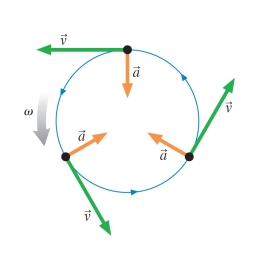
The mass point moves evenly along a circle with a radius of 1.2 m at an angular velocity of 25 rad/s. Determine the frequency, period, and centripetal acceleration!
Your answer:
Your answer:
Tips for related online calculators
Do you want to convert velocity (speed) units?
You need to know the following knowledge to solve this word math problem:
planimetryUnits of physical quantitiesthemes, topicsGrade of the word problem
We encourage you to watch this tutorial video on this math problem: video1
Related math problems and questions:
- Circular motion
 The mass point regularly moves in a circle with radius r = $r m angular velocity ω = 4.3 rad/s. Calculate the period, frequency, and centripetal acceleration of this movement.
 - Rotational motion of a cylinder
 Calculate the kinetic energy of a cylindrical body with radius r = 0.08 m and mass m = 1.5 kg at time t = 5 s, given that the body rotates about an axis through the centre of the cylinder with a constant angular acceleration ε = 5 rad/s², starting from re
 - Constant Angular Acceleration
 The particle began to move from rest along a circle with a constant angular acceleration. After five cycles (n = 5), its angular velocity reached the value ω = 12 rad/s. Calculate the magnitude of the angular acceleration ε of this motion and the time int
 - Disc angular speed
 1. A disc makes 15 revolutions per minute. Determine his angular speed and the boy's speed on the seat that describes a circle with a radius of 5 m. 2. The grinding wheel rotates at 600 revolutions per minute. Determine the period and angular velocity. Th
 - Two mass points
 Two mass points start moving simultaneously in the same direction from the same location: the first point moves uniformly at a speed of 50 cm/s, and the second point moves with uniform acceleration from rest at an acceleration of 10 cm/s². Determine: a) t
 - Accelerated motion
 The position of a mass point that moves along the x-axis is given by the relation x=10t²-5t. Express its velocity and acceleration.
 - Overload
 Calculate how many g's (gravity accelerations) the glider pilot when turning the horizontal circles of radius 139 m flying at 126 km/h. Centripetal acceleration is proportional to the square of the speed and inversely proportional to the radius of rotatio