On a mass
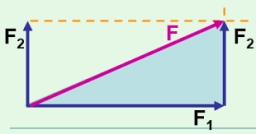
Forces F₁ and F₂, each with a magnitude of 40 N, act on a mass point M. Their resultant has a magnitude of 60 N. Determine the angle between forces F₁ and F₂.
Your answer:
Your answer:
Tips for related online calculators
The Pythagorean theorem is the base for the right triangle calculator.
Cosine rule uses trigonometric SAS triangle calculator.
See also our trigonometric triangle calculator.
Try conversion angle units angle degrees, minutes, seconds, radians, grads.
Cosine rule uses trigonometric SAS triangle calculator.
See also our trigonometric triangle calculator.
Try conversion angle units angle degrees, minutes, seconds, radians, grads.
You need to know the following knowledge to solve this word math problem:
algebraplanimetrygoniometry and trigonometryUnits of physical quantitiesthemes, topicsGrade of the word problem
Related math problems and questions:
- Mass point
 Two equal forces of 30 Newtons act on a mass point. Find the magnitude of the resultant force if these forces form an angle of 42°.
 - Two forces 3
 Two forces with magnitudes 8 Newtons and 15 Newtons act at a point. Find the angle between the forces if the resultant force is 17 Newtons.
 - Forces
 At point G, three mutually perpendicular forces act: F₁ = 16 N, F₂ = 7 N, and F₃ = 6 N. Determine the resultant force F and the angles between F and each of F₁, F₂, and F₃.
 - Forces
 Forces with magnitudes F1 = 42 N and F2 = 35 N act at a common point and make an angle of 77°12'. How big is their resultant?
 - Two forces
 Two forces with magnitudes of 25 and 30 pounds act on an object at 10° and 100° angles. Find the direction and magnitude of the resultant force. Round to two decimal places in all intermediate steps and your final answer.
 - Three vectors
 The three forces whose amplitudes are in ratio 9:10:17 act in the plane at one point to balance. Determine the angles of each of the two forces.
 - Beam force distribution
 A body weighing 400 kg is suspended at a distance of 1 m from one end of the beam on a beam weighing 100 kg and 5 m. How large do forces act at the ends of the beam?