Divide an isosceles triangle
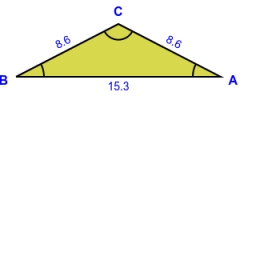
How can an isosceles triangle be divided into two parts with equal areas perpendicular to the axis of symmetry (into a trapezoid and a triangle)?
Your answer:
Your answer:
Tips for related online calculators
See also our right triangle calculator.
Calculation of an isosceles triangle.
See also our trigonometric triangle calculator.
Calculation of an isosceles triangle.
See also our trigonometric triangle calculator.
You need to know the following knowledge to solve this word math problem:
geometryarithmeticplanimetrybasic operations and conceptsUnits of physical quantitiesthemes, topicsGrade of the word problem
We encourage you to watch this tutorial video on this math problem: video1
Related math problems and questions:
- Czech flag
 Calculate the areas of the colored parts on Czech flag in the shape of a rectangle with dimensions of 2 m and 1 m. White and red form half the width, the blue triangle is isosceles, and its apex is half the length.
 - Diagonal intersect
 Isosceles trapezoid ABCD with length bases | AB | = 6 cm, CD | = 4 cm is divided into four triangles by the diagonals intersecting at point S. How much of the area of the trapezoid are ABS and CDS triangles?
 - MO - triangles
 On the AB and AC sides of the ABC triangle lies successive points E and F, and on segment EF lie point D. The EF and BC lines are parallel. It is true this ratio FD:DE = AE:EB = 2:1. The area of the ABC triangle is 27 hectares, and line segments EF, AD, a
 - Fraction and ratios
 Fraction and ratios are different names for the same thing.
 - A cone 4
 A cone with a radius of 10 cm is divided into two parts by drawing a plane through the midpoint of its axis parallel to its base. Compare the volumes of the two parts.
 - Cone
 Into rotating cone with dimensions r = 8 cm and h = 8 cm is an inscribed cylinder with maximum volume so that the cylinder axis is perpendicular to the cone's axis. Determine the dimensions of the cylinder.
 - Axes of Symmetry
 Draw a circle k (S, r = 2 cm). Mark the three axes of symmetry of the circle defined by this circle. Each axis of symmetry of the circle passes through __________.