Right-angled triangle
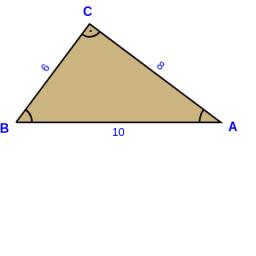
Determine the area of a right triangle whose side lengths form successive members of an arithmetic progression, and the radius of the circle described by the triangle is 5 cm.
Your answer:
Your answer:
Tips for related online calculators
Are you looking for help with calculating roots of a quadratic equation?
Do you have a linear equation or system of equations and are looking for a solution? Or do you have a quadratic equation?
See also our right triangle calculator.
See also our trigonometric triangle calculator.
Do you have a linear equation or system of equations and are looking for a solution? Or do you have a quadratic equation?
See also our right triangle calculator.
See also our trigonometric triangle calculator.
You need to know the following knowledge to solve this word math problem:
algebraplanimetryUnits of physical quantitiesGrade of the word problem
We encourage you to watch this tutorial video on this math problem: video1
Related math problems and questions:
- Arithmetic geometric sequence
 Determine four numbers so that the first three form the successive three terms of an arithmetic sequence with difference d=-3 and the last three form the next terms of a geometric sequence with quotient q=one half.
 - Triangle arithmetic sides
 The lengths of the sides of a right triangle form the first 3 terms of the arithmetic sequence. Its area is 6 cm². Find length of its sides.
 - GP - edge lengths
 The block edge lengths are made up of three consecutive GP members. The sum of the lengths of all edges is 84 cm, and the volume block is 64 cm³. Determine the surface of the block.
 - Rectangular triangle
 The lengths of the rectangular triangle sides with a longer leg of 12 cm form an arithmetic sequence. What is the area of the triangle?
 - Triangle
 In triangle ABC, point S is the incentre (centre of the inscribed circle). The area of quadrilateral ABCS equals four-fifths of the area of triangle ABC. The side lengths of triangle ABC are all integers expressed in centimetres, and the perimeter of tria
 - Chord distance
 Determine the distance of two parallel chords of lengths of 7 cm and 11 cm in a circle with a radius of 7 cm.
 - Consecutive members The block has a volume of 1728 cm³. Determine the lengths of the edges a, b, and c of the blocks for which a < b < c and a + b + c = 38 cm and whose numerical values in cm represent three consecutive members of the geometric sequence.