Quadrangular block
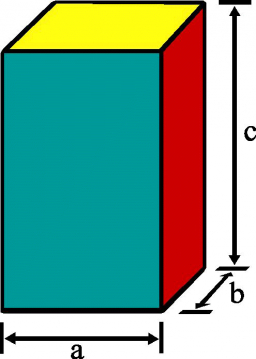
The surface of the quadrilateral block is 3.4 dm2. The edges of the block are 8 cm and 10 cm long. Calculate the volume of the block.
Your answer:
Your answer:
Tips for related online calculators
Tip: Our volume units converter will help you convert volume units.
You need to know the following knowledge to solve this word math problem:
solid geometryplanimetryUnits of physical quantitiesGrade of the word problem
We encourage you to watch this tutorial video on this math problem: video1
Related math problems and questions:
- Block surface ratio
 The volume of the block is 7,500 dm³. The lengths of the edges are in the ratio 3: 4: 5. Calculate the surface area of the cuboid.
 - Prism height calculation
 Calculate the height of a regular quadrilateral prism whose base is a rhombus. The edge in the base is 7 cm long, the opposite edges are 5 cm apart, and we also know that the entire body has a volume of 1 dm³.
 - Pyramid Height Surface Area
 The regular quadrilateral pyramid has a base diagonal of 5√2 cm, and the side edges are 12√2 cm long. Calculate the height of the pyramid and its surface.
 - Quadrilateral surface area
 Calculate in dm² the surface of a quad whose edges have 1.2 dm, 1.4 dm, and 2 dm.
 - Cuboid and cube
 A block with edges of lengths of 10 cm and 8 cm has the same volume as a cube with an edge of the length of 1 dm. Calculate the third dimension of the block. Compare the ratio of the surfaces of both bodies.
 - Pyramid measurements
 Calculate the surface area and volume of a regular quadrilateral truncated pyramid if the base edges are 87 cm and 64 cm and the wall height is 49 cm.
 - Pyramid volume calculation
 The area of a regular quadrilateral pyramid's mantle is equal to twice its base's area. Calculate the pyramid's volume if the base edge's length is 20 dm.