Base RR odd
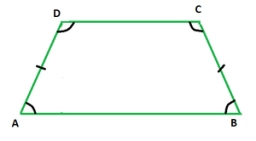
The base of a prism is an isosceles trapezoid ABCD with bases AB = 12 cm and CD = 9 cm. The angle at vertex B is 48°10′.
Determine the volume and surface area of the prism if its height is 35 cm.
Your answer:
Determine the volume and surface area of the prism if its height is 35 cm.
Your answer:
Tips for related online calculators
See also our right triangle calculator.
Do you know the volume and unit volume, and want to convert volume units?
Calculation of an isosceles triangle.
See also our trigonometric triangle calculator.
Try conversion angle units angle degrees, minutes, seconds, radians, grads.
Do you know the volume and unit volume, and want to convert volume units?
Calculation of an isosceles triangle.
See also our trigonometric triangle calculator.
Try conversion angle units angle degrees, minutes, seconds, radians, grads.
You need to know the following knowledge to solve this word math problem:
algebraarithmeticsolid geometryplanimetrygoniometry and trigonometryUnits of physical quantitiesGrade of the word problem
Related math problems and questions:
- Trapezoid height angle
 In the isosceles trapezoid ABCD, its bases AB = 20 cm, CD = 12 cm and arms AD = BC = 8 cm are given. Specify its height and alpha angle at vertex A
 - Trapezoidal prism
 Calculate the surface of the quadrilateral prism ABCDA'B'C'D' with the trapezoidal base ABCD. The height of the prism is 12 cm; Trapezoid ABCD has the following dimensions: AB base length is 8 cm, CD base length is 3 cm, BC arm length is 4 cm, and AC diag
 - Diagonal intersect
 Isosceles trapezoid ABCD with length bases | AB | = 6 cm, CD | = 4 cm is divided into four triangles by the diagonals intersecting at point S. How much of the area of the trapezoid are ABS and CDS triangles?
 - Internal angles
 The ABCD is an isosceles trapezoid, which holds: |AB| = 2 |BC| = 2 |CD| = 2 |DA|: On the BC side is a K point such that |BK| = 2 |KC|, on its side CD is the point L such that |CL| = 2 |LD|, and on its side DA, the point M is such that | DM | = 2 |MA|. Det
 - Pillar - bricks
 A brick pillar has the shape of a four-sided prism with an isosceles trapezoid base with parallel sides a = 55 cm and c = 33 cm, leg b = 33 cm, and trapezoid height vₐ = 32.1 cm. The pillar is 1.9 m high. How many bricks were used to build it if one brick
 - The bases
 The bases of the isosceles trapezoid ABCD have 10 cm and 6 cm lengths. Its arms form an angle α = 50˚ with a longer base. Calculate the circumference and area of the ABCD trapezoid.
 - Trapezoid angles
 Given an isosceles trapezoid ABCD, in which | AB | = 2 | BC | = 2 | CD | = 2 | DA | holds. On its side BC, the point K is such that | BK | = 2 | KC |; on its CD side, the point L is such that | CL | = 2 | LD |, and on its DA side, the point M is such that