Cutting cone
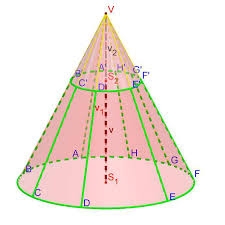
A cone with a base radius of 10 cm and a height of 12 cm is given. At what height above the base should we divide it by a section parallel to the base so that the volumes of the two resulting bodies are the same? Express the result in cm.
Your answer:
Your answer:
Tips for related online calculators
Check out our ratio calculator.
Do you want to convert length units?
See also our trigonometric triangle calculator.
Do you want to convert length units?
See also our trigonometric triangle calculator.
You need to know the following knowledge to solve this word math problem:
geometryalgebrasolid geometryplanimetrybasic operations and conceptsUnits of physical quantitiesGrade of the word problem
We encourage you to watch this tutorial video on this math problem: video1
Related math problems and questions:
- Cross-sections of a cone
 Cone with base radius 15 cm and height 20 cm divided by parallel planes to base into three bodies. The planes divide the height of the cone into three equal parts. Determine the volume ratio of the maximum and minimum of the resulting body.
 - A cone 4
 A cone with a radius of 10 cm is divided into two parts by drawing a plane through the midpoint of its axis parallel to its base. Compare the volumes of the two parts.
 - Pyramid volume ratio
 A regular quadrilateral pyramid with base edge length a = 15 cm and height v = 21 cm is given. We draw two planes parallel to the base, dividing the height of the pyramid into three equal parts. Calculate the ratio of the volumes of the 3 bodies created.
 - Cone
 A circular cone of height 14 cm and volume 4396 cm³ is cut at one third of its height (measured from the base) by a plane parallel to the base. Calculate the radius and circumference of the circular cross-section.
 - The cone
 The cone has a base radius of 12 cm and a height of 20 cm. It was truncated at 6 cm from the base. We created a truncated cone - frustum. Find the radius of the base of the truncated cone.
 - Cylinder and Cuboid Volume
 A block with a square base is inserted into a 10-centimeter-high cylinder in such a way that its base is inscribed in the base of the cylinder. The edge of the base of the block measures 4 cm. Both bodies have the same height. Calculate the difference bet
 - Cube body surfaces
 We assemble different bodies from five identical cubes. The volumes of all bodies are equal. Calculate the surfaces of the assembled bodies.