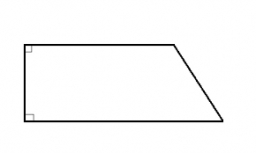
Right-angled trapezoid
A right-angled trapezoid with the measure of the acute angle of 50° is given. The lengths of its bases are 4 and 6 units. The volume of the solid obtained by rotation of the given trapezoid about the longer base is:
Your answer:
Your answer:
Tips for related online calculators
Do you know the volume and unit volume, and want to convert volume units?
See also our trigonometric triangle calculator.
Try conversion angle units angle degrees, minutes, seconds, radians, grads.
See also our trigonometric triangle calculator.
Try conversion angle units angle degrees, minutes, seconds, radians, grads.
You need to know the following knowledge to solve this word math problem:
solid geometryplanimetrybasic operations and conceptsgoniometry and trigonometryUnits of physical quantitiesGrade of the word problem
We encourage you to watch this tutorial video on this math problem: video1
Related math problems and questions:
- The bases
 The bases of the isosceles trapezoid ABCD have 10 cm and 6 cm lengths. Its arms form an angle α = 50˚ with a longer base. Calculate the circumference and area of the ABCD trapezoid.
 - An isosceles trapezoid
 An isosceles trapezoid has base angles of 50° each, and its bases are 20 cm and 30 cm. Compute its area.
 - Triangle cone rotation
 A thin plate in the shape of a right-angled triangle is turned once around the shorter hanger and a second time around the longer hanger. Cones are described by rotation. Are they the same volume? The dimensions are: shorter pendant 6 cm, longer pendant 8
 - Trapezoid side lengths
 The circumference of the isosceles trapezoid is 34 cm. The difference in the length of the bases is 6 cm. The arm's length is one-third of the length of the longer base. Find the lengths of the trapezoidal sides.
 - Quadrilaterals
 Which of the following statements about angles in quadrilaterals is false? a. In a right-angled trapezoid, exactly one interior angle is obtuse. b. The diagonals of a rhombus are perpendicular to each other. c. The sum of any two interior angles on the sa
 - Base RR odd
 The base of a prism is an isosceles trapezoid ABCD with bases AB = 12 cm and CD = 9 cm. The angle at vertex B is 48°10′. Determine the volume and surface area of the prism if its height is 35 cm.
 - Triangle ABC
 Triangle ABC has side lengths m − 1, m − 2, and m − 3. What must m be for the triangle to be: a) right-angled? b) acute-angled?